How to Find YouTube Keywords: Five Free Sources I Check Before Any Script
Nobody is ignoring your video. They do not know it exists.
There was a stretch early on where I believed the comfortable version of this job: make something genuinely good, and the audience will find it. Then I published a run of videos that I was proud of and that almost nobody watched, and the belief did not survive contact with the analytics.
The uncomfortable read was not that people had seen my video and passed. It was that the video had never been offered to them in the first place. I had made something nobody was looking for, in words nobody was typing.
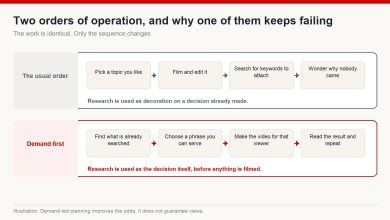
So I started pulling apart how creators aimed at English-speaking audiences actually pick topics, and one habit showed up again and again: the fast-growing channels almost never invent a subject from a blank page. They find the phrase first, then build the video around it. That ordering is the whole difference, and it is why some uploads have views on day one while others sit at forty for a month.
This article is the five places I look before a script exists. None of them cost anything.
Why the phrase matters more than the idea
A brilliant idea that nobody searches for is still a brilliant idea. It is just not a video with an audience attached to it yet.
An ordinary topic that sits on real demand, meanwhile, can pull steady views for months, because there is a continuous trickle of people typing that thing into the search bar and a system looking for something to hand them.
This gets more important, not less, when you are publishing to an audience whose language and daily life are not yours. If you are running a faceless channel for viewers in the US, the UK, Germany or Japan, you cannot feel your way to what they want. Intuition is not available to you. The phrase they type is the only honest signal you have, and reading it properly is what how to find youtube keywords actually means in practice.
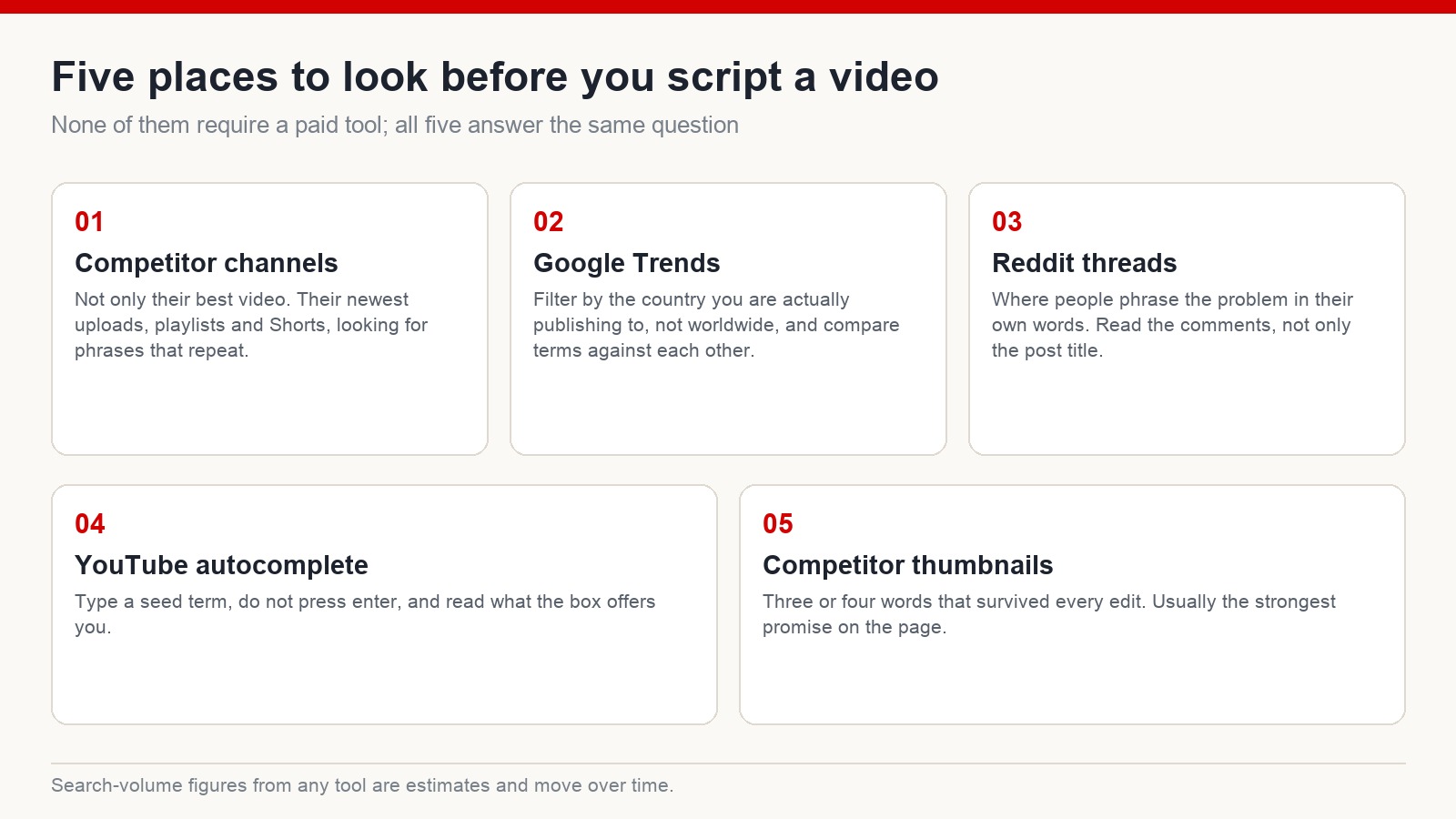
1. Competitor channels
This is always where I start, and the mistake almost everyone makes is opening the channel and watching the single most-viewed video. That video is an outlier. It tells you what worked once, often for reasons nobody can reproduce.
What tells you more is the boring stuff around it:
- Their most recent uploads, which show what they are betting on now
- Videos that are climbing rather than videos that already peaked
- Playlist names, which are usually written for search
- Their Shorts, which are cheap experiments and therefore honest
- The format they publish week after week without fail
Then write down the phrases that repeat. Not the topics — the actual wording. When four unrelated channels all use the phrase “faceless channel” rather than “anonymous channel”, that is not a coincidence, that is the vocabulary the audience has settled on. Copying the wording is research. Copying the video is not.
2. Google Trends, filtered by country
Search interest is not stable. Some phrases have been climbing for three years, some peaked eighteen months ago and are now quietly dying, and from a single search box you cannot tell those two apart.
Google Trends is free and it separates them. Use it to compare two or three candidate phrases against each other rather than looking at one in isolation, and check the shape of the curve over five years, not ninety days.
The setting that matters most is the country filter. If you are publishing for a US audience, worldwide data is actively misleading — it blends in markets you are not serving and languages you are not publishing in. Set the region to the country you actually want, look at the sub-regions if the topic is at all local, and treat the worldwide view as noise.
3. Reddit, where people phrase the problem themselves
This is the source most creators skip, and it is the one that changes titles the fastest.
Search boxes give you compressed language. People type three words because typing is a chore. On Reddit, the same person writes six sentences explaining what they tried, what went wrong and what they are afraid of — which is where the video is.
What I am reading for:
- The same question asked over and over in slightly different words
- Threads with a lot of comments but a thin original post — the demand is in the replies
- The exact phrasing of the frustration, which often makes a better title than anything I would have written
Read the comments, not just the post titles. A thread titled “help” can contain the clearest description of a problem you will find all week.
4. YouTube autocomplete
The simplest one, and it takes about ninety seconds. Type a seed phrase into the YouTube search box and do not press enter. Read what the box offers you. Those suggestions are built from things people genuinely search for, and they cost nothing to collect.
Type ai video and you are likely to be offered things in the shape of:
- ai video generator
- ai video editing
- ai video generator free
- ai video for beginners
- ai video tutorial
Suggestions change by region, by language and by what you have watched, so check in a logged-out or private window if you want a cleaner read. Then push it further: put a letter after your seed term, one at a time, and the box will fan out into phrases you would never have guessed at. This is expansion without invention, which is exactly what you want at this stage.
5. The words on competitor thumbnails
This sounds like a design exercise. It is not. It is the cheapest audience research available.
A title has room to be careful. A thumbnail has room for three or four words, which means those words have survived every round of cutting. Whatever is left is what the creator believed was the strongest promise on the page.
You will often find the title and the thumbnail are doing two different jobs. The title reads How I Grew My Channel in 90 Days; the thumbnail says 0 to 100K. The title is for search. The thumbnail is for the click. Both are keyword information, and the second one is usually more revealing about what the audience actually wants.
So when you go through competitors, log the thumbnail words separately: which words recur, how results get framed, where curiosity is created. It will improve your titles as much as your images.
The six-step sweep, in order
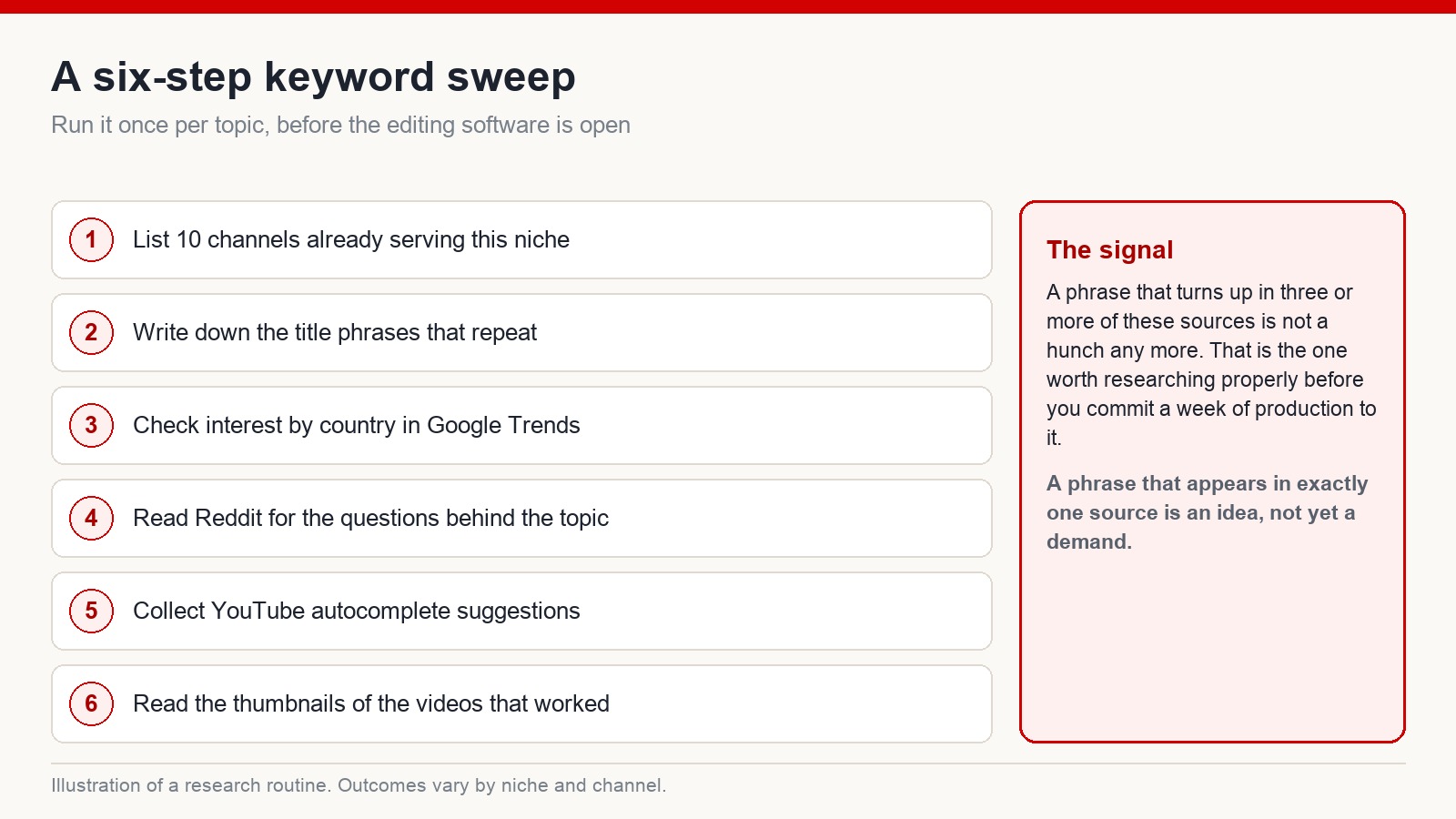
Before I commit a week of production to anything, I run the same short loop:
- List ten channels already serving this niche properly
- Write down the title phrases that repeat across them
- Check interest by country in Google Trends, over years not weeks
- Read Reddit for how people describe the problem in their own words
- Collect YouTube autocomplete suggestions from three or four seed terms
- Log the words on the thumbnails of the videos that clearly worked
The output is not a keyword. It is a shortlist, and then one rule sorts it: if the same phrase turns up in three or more of those sources, it is worth real research. If it appears in exactly one, it is an idea I like, which is a different thing entirely and has misled me more than once.
The whole sweep takes maybe thirty minutes. It has saved me from dozens of hours spent building videos for an audience that was never there.
Do not simply chase the biggest number
The obvious trap is sorting by search volume and taking the top row. Two problems with that.
First, the biggest phrases are where the biggest channels live, and a new channel entering that room is competing against years of accumulated watch history. Second, volume figures from any tool are estimates. They are modelled, they disagree between tools, and they move month to month. Treat them as a rough ordering, never as a measurement.
The better question is not “what has the most searches” but “where can I make something clearly better or clearly different from what already ranks”. A narrower phrase with moderate competition, where the existing videos are lazy, is a far more realistic opening than a huge term where the top five results are excellent.
What keyword research will not do
I want to be straight about the limits, because this topic attracts a lot of overclaiming.
Research tells you a phrase has demand. It does not tell you the video will be watched. Retention, the thumbnail, the first thirty seconds and whether the video actually delivers what the title promised all sit downstream of this work and can undo all of it. Recommendation behaviour also changes; what pulls views this quarter may not next year. Results vary enormously by niche, by market and by how much you have already published.
What research does reliably is stop you making things nobody asked for. That is a smaller claim than the internet usually makes, and it is still the highest-leverage half hour in the whole process.
Should I use only one source for keyword ideas?
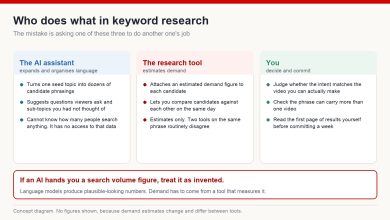
No. Each source is biased in its own direction — competitors show you what is already served, Reddit shows you what is unsolved, autocomplete shows you compressed search language. The signal comes from the overlap between them, which is why the shortlist rule is three sources, not one.
Is a high-volume keyword always better?
No. High volume usually means high competition, and a new channel rarely wins that fight. A narrower phrase that matches real demand can bring smaller but far more relevant traffic, and relevant viewers are what teach the system who to show you to next.
Should I copy a competitor’s title?
No — analyse the structure, not the sentence. Notice what promise it makes, how specific it is and where the curiosity sits, then write your own version that reflects what your video actually delivers. A copied title on a different video is a broken promise, and viewers leave immediately.
Start with the search box, not the timeline
The change that made the most difference to my own work was simply moving keyword research to before the editing software opens rather than after the export finishes. Thirty minutes understanding what a market is asking for beats thirty hours making something for nobody.
Good creators are not better guessers. They just guess less. They look, they check, they confirm the demand is real, and only then do they start building.
If you want the full process for building a faceless channel aimed at English-speaking audiences, that is what I teach at mmoyoutube.com.